
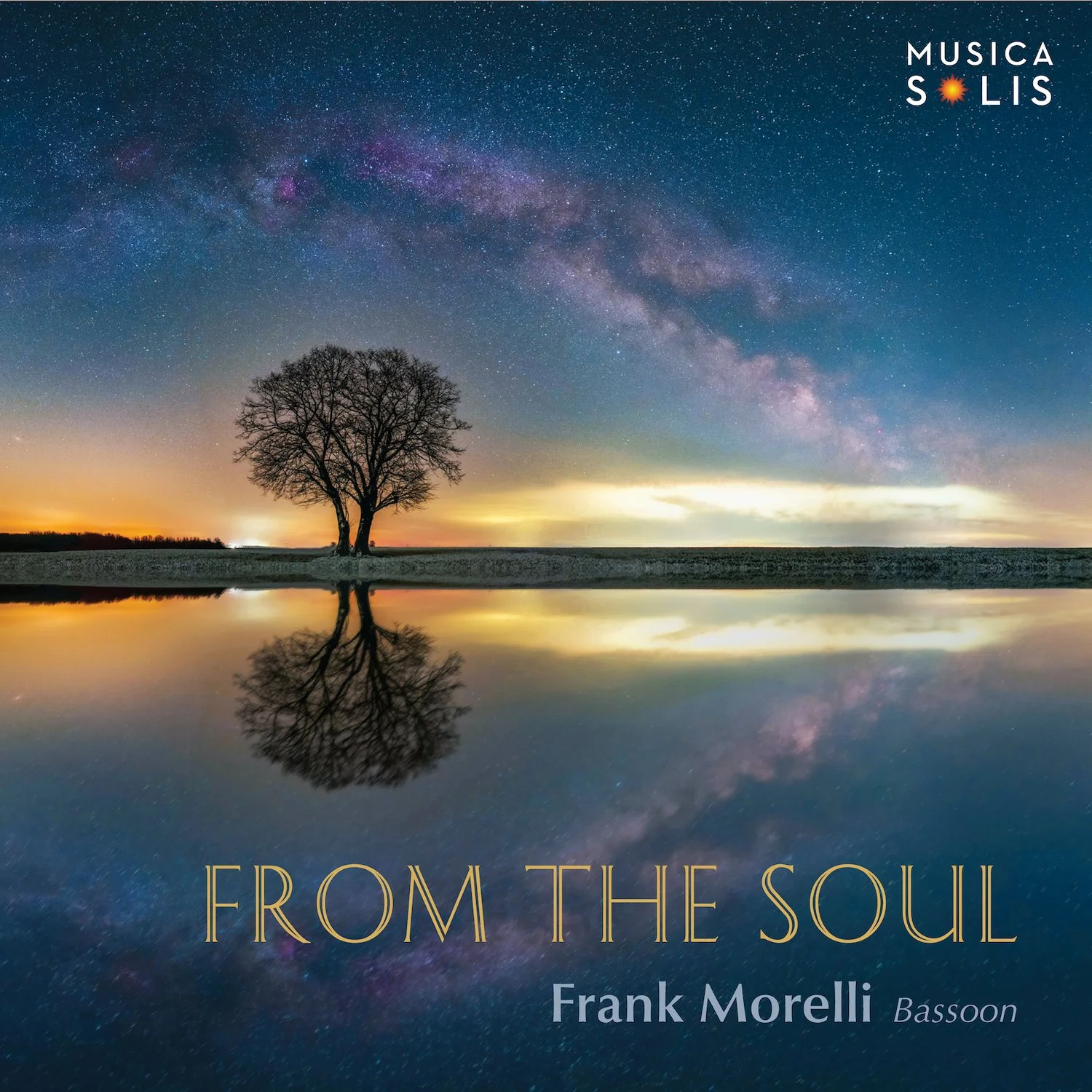
Bassoonist Frank Morelli’s new album “From the Soul,” will be released on Musica Solis on February 20, 2026. The collection features works by Wynton Marsalis, Dominick Argento, Lori Laitman, Jeff Scott, and Nirmali Fenn. We asked him to share additional information about the music on the album and his connections to it. This is his response.
I’ve had, and continue to have, the good fortune to take part in nearly two hundred recordings with the Orpheus Chamber Orchestra and other chamber ensembles. Although I was often highlighted on these CDs, somehow I felt I had more to share personally, and if I intended to accomplish my goals, I had better get going. The defining impetus for my first series of self-produced solo albums was the approach of my 50th birthday, now nearly twenty five years ago. Those first four solo albums, on the MSR label, presented “Classical” or concert music spanning from the Baroque, (“Baroque Fireworks”) through the late 18th to early 20th centuries, (“Romance and Caprice”) to music later in the 20th century (“Bassoon Brasileiro” and “From the Heart”).
As I saw my 70th birthday on the horizon, I realized that I still had even more I wished to share. During this latest creative period, my first “classical” album, released by Musica Solis in 2024, “An die Musik,” is my statement of gratitude for a lifetime in music. It looks back to the masters Schubert, Schumann and Brahms. My newest Musica Solis album, “From the Soul” presents music of today and also looks to the future. I have selected five pieces for “From the Soul” that are personal to me. One aspect of that connection is literal. I have had the pleasure of knowing four of the five composers personally. I met the fifth, Dominick Argento, when I performed his opera “Casanova’s Homecoming” at Lincoln Center during the years I served as principal bassoon of the New York City Opera Orchestra. From that time I felt a special connection to his compositional voice, a feeling I share for each of the other four composers whom I have known more intimately. Each work heard on this album speaks from the soul. Along with soulfulness, the thematic through-line examines the concept of innocence and the human spirit. Thus we begin with an elegy for innocence and end with a prayer for peace and kindness. In addition, each work demands great flexibility in tone and style. My guiding principal as a bassoonist is that the bassoon is my voice-not a machine. The instrument lends itself to a vocal style of playing. Being a double reed instrument with a conical bore, the variety of tone colors and characters available to me is rather infinite. Each selection heard here demands a different bassoon, if you will.
Elegy for Innocence (2008) by Jeffrey Scott (1976- ) is the perfect “keynote address” for this compilation. Jeff recalls:
I was contemplating the innocence one has as he/she starts out in life and the bittersweet journey as the expectation of life’s offerings yield to the reality.” Elegy for Innocence begins… “with a simple, Copland-esque opening, a sinister almost uninvited middle section, followed by a melancholic solo bassoon melody, ending with a virtuosic and optimistic finish.
Playing this work with my dear friend and colleague, pianist Wei-Yi Yang, Mr. Scott’s music speaks “from the soul” from the opening lullaby through the twists and turns that follow. I’ve known Jeff Scott since early in his career. It has been a joy to perform with him and admire his growth as an artist and composer. He wrote this work for his dear friend, and my former student, the exceptional bassoonist, Monica Ellis, who is now a leader in our field. I was present at its premier and I will always remember the joy I felt in witnessing their triumph.
In describing her song cycle I Never Saw Another Butterfly (1996) Lori Laitman (1955- ) shares:
One cannot help but be touched by the hope, innocence and truth of the poems. The cycle progresses from feelings of innocence and hope to those of despair and sorrow. Composed in 1996 for solo voice with alto saxophone, I Never Saw Another Butterfly was my first Holocaust-themed song cycle… using texts from an astonishing collection of poems written by children from the Terezin Concentration Camp killed in the Holocaust [at Auschwitz.] The bassoon version was specifically composed for Frank Morelli to perform on Ruth Sommers’ 2002 Festival Chamber Music concert at Merkin Hall in NYC. ‘The Butterfly’ opens with a cantorial-style bassoon line, conjuring up images of a fluttering butterfly. Despite the tremendous sadness of the text, the message of the poem is one of undying spirit. ‘Yes, That’s the way things are’ was written by three children -- Kosek, Löwy, and Bachner — who wrote under the name Koleba. To reflect the irony of the poem, I created music…typical of Jewish folk song. The author of ‘Birdsong’ is unknown. [M]ost striking is the author’s ability to rise above the horrid living conditions to focus on the loveliness of life. The feelings of hope manifested in the earlier songs die in ‘The Garden’. The little boy walking along the garden path is portrayed by a weaving bassoon part with subtle rhythmic changes. Both parts build to a climax, then abruptly come to a close as ‘the little boy will be no more.’ ‘Man Proposes, God Disposes’ was also written by the three children who signed their name Koleba. The poem recognizes that those who were ‘rich before’ would perish much faster in the camps than those accustomed to a harsher life. ‘The Old House’, also written by Franta Bass, ends the cycle. The barren image of the deserted house is captured by the muted bassoon repeatedly playing one note, like a bell tolling.
Having performed this profound cycle together a number of times, the outstanding mezzo soprano Janna Baty and I are grateful to share it on this album.
A Man with a Paint Box Aria “Once, when I was a young man” from the opera “Postcard from Morocco” (1971) by Dominick Argento (1927-2019) compels the bassoonist to “sing” in a more operatic style. In Argento’s own words:
my music is lyrical because it’s sung. I have gone on record as saying my whole purpose in writing music is to communicate with an audience, and to move them, to make them laugh or weep. That is the fundamental aspect of music.
As a singing bassoonist, I identify very closely with his thinking. In the aria, Argento portrays an older man’s recounting of an innocent, youthful fantasy in which an imaginary ship docks in the clouds outside his bedroom window. In this instance the bittersweet and complicated feelings of the storyteller are more subtle, lacking the severity of the underlying tragedy of Laitman’s song cycle.
Meeelaan (2000) by Wynton Marsalis (1961- ) is original, deeply felt and soulful, mirroring the composer on many levels. I have known Wynton since he first moved to New York City in his late teens. He wrote this work for his and my friend, the eminent bassoonist Milan Turkovic. The title refers to the way Wynton Marsalis would often greet Milan. Excerpted from Marsalis’ official biography found on his website: “Marsalis performs and composes across the entire spectrum of jazz and has written jazz-influenced chamber music and symphonic works for revered classical ensembles across the US and abroad. He is inspired to experiment in an ever-widening palette of forms and concepts that constitute some of the most advanced thinking in modern jazz and in American music on the broad scale.” Meeelaan surely fits this description with great writing that requires the bassoonist and the outstanding Callisto Quartet to “turn on a dime” from one expressive quality to the next. The bassoonist is required to create a sound perhaps more reminiscent of a tenor or baritone saxophone. The result is an original and wide-ranging mixture of various styles from blues to tango to bebop, but the overall effect is a unified message that is soulful on many levels.
This debut recording of, Prayer, written for me in 2022 by my dear friend, composer Nirmali Fenn, (1979- ) brings From the Soul’s journey to a meaningful close. The composer states: “The piece unfolds as a journey through body, soul, and spirit, with prayer acting as a channel that connects these dimensions.” The bassoonist is required to conjure up the sound and style of the Armenian duduk, a double reed instrument similar in size to the oboe. The use of jaw vibrato and alternate fingerings create varied tone colors unlike the more familiar sounds one might expect to hear, or heard earlier on this album. In the final section of the composition the pianist places a “singing bowl” on the piano’s G4 string, first causing it to vibrate and then gliding it along the string creating an ethereal effect. The composer states:
Prayer is a piece born from collaboration, a testament to how friendship can spark creation. Before composing, Frank asked for a piece that could evoke a spiritual intensity of the Muslim call to prayer. For months, I listened to adhans, only to find my inner ear forging the haunting duduk-like solo that is at the center of this piece. Together, we sculpted the opening over weeks of collaboration; I still recall Frank’s instruction – “make it operatic.” Composing Prayer was pure joy: when collaborators magnify each other’s ideas, the process becomes a journey of discovery, leading to surprising new worlds of sound. Throughout its creation, one question stayed with me: what is prayer for? Beyond religion, I believe prayer is a search for unity, an act of resistance against conflict. The message behind Prayer is simple. We all belong to something larger than ourselves, and that truth leaves no room for war.
And so, there’s a through-line of expression and feeling from an elegy for innocence, to the innocent words of children murdered in the holocaust, to a young man whimsically recalling his youth, to the soulful, often jazz-inflected expressions of Wynton Marsalis, to an other-worldly prayer. The works, individually and taken together, require as large a spectrum of sounds, characters and expression as is possible.
An invaluable asset of being a bassoon teacher is that some former students have become part of my “bassoon family.” One of my students, Susan Lansing, married an outstanding saxophonist and jazz recording artist in Denver, Keith Oxman. This “family connection” opened the door back to my first musical passion. I found the golden opportunity during these past five years to return to the music of my early days, when my love of playing was fueled by the popular standards we enjoyed at home, sung by great artists like Ella Fitzgerald and Frank Sinatra. I would spend hours on my sax playing these tunes out of a “fake book” - a compendium of hundreds of those standards. I am by no means a jazz musician. That would imply a level of ability beyond me. However, in that period of my life I did gain experience performing popular standards in a style that I felt comfortable bringing to the bassoon. In my two albums with Keith, my approach to sound, articulation, bending notes, vibrato, etc. are definitely related to my years on the saxophone, which, by the way, I gave up several decades ago! As a “classically-trained” musician I needed to find a place for myself with Keith and his excellent jazz colleagues. My solution has been to focus on the connection between concert, or classical music and popular standards and jazz. You could say “the concert hall meets the music hall.” Our first album, the OX-MO Incident on the Capri label (2021) has been very well received. In late 2025 we recorded the tracks for our next album, also to be released by Capri in 2026. The title will be CLASSICOOL.
So this latest five-year period of productivity has been extremely rewarding, celebrating sixty years of bassooning. My personal goal and message to my students is that the bassoon is your voice. Play and revel in all the genres of music that represent your passions. The sky is the limit. That has been my approach from my earliest days in music. I am eternally grateful to all involved in bringing these passion projects to life.