
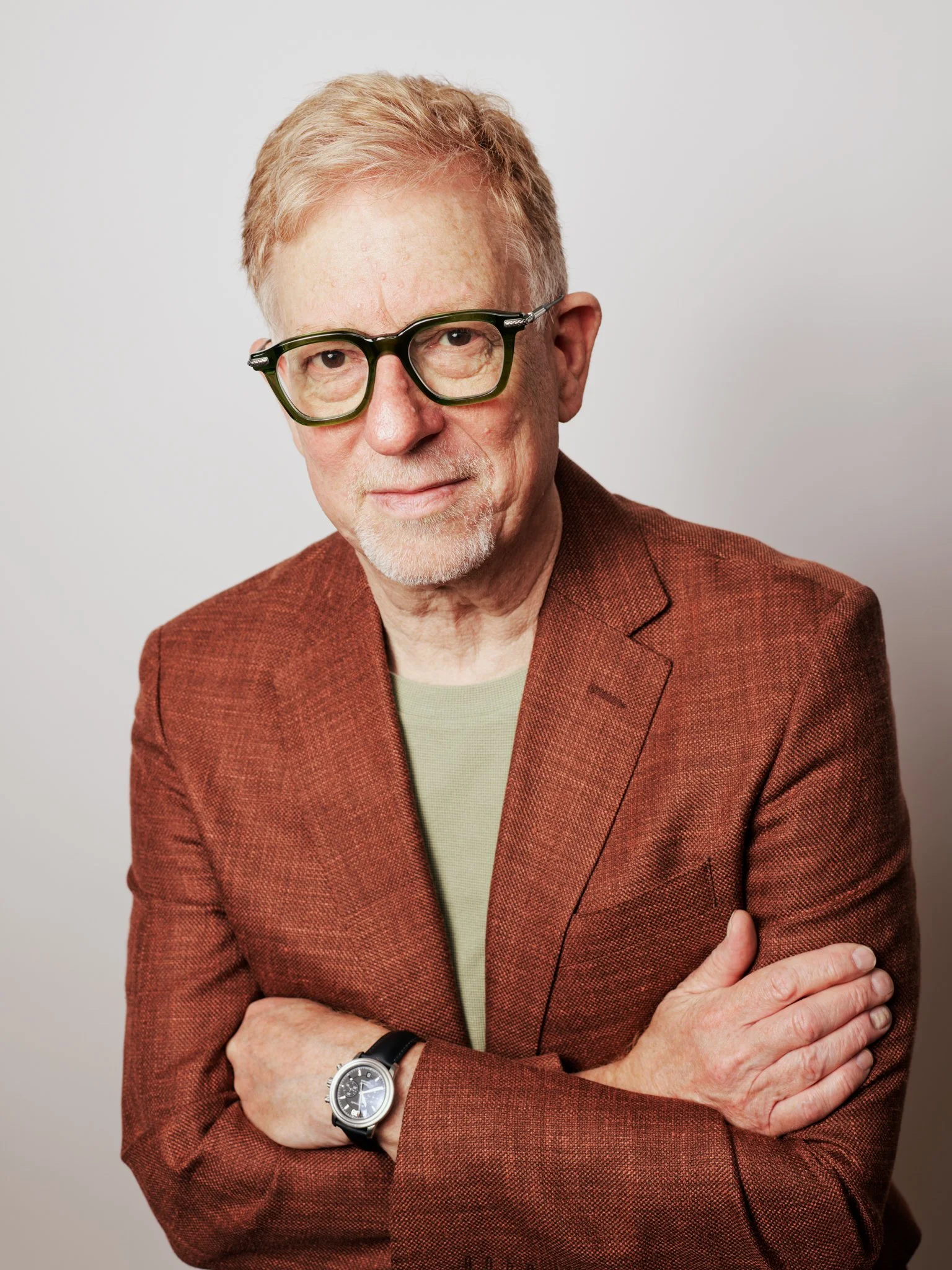
Drawing from every corner of the soundworld, composer Eric Chasalow creates genre-defying music. On April 17, 2026, his latest album “arching, reaching, breathless” is released on New Focus Recording. The album is a survey of Chasalow’s works written for string instruments spanning over 30 years. We spoke with the composer about the new album, his approach to composing electroacoustic music, the oral history project he created - now in the Library of Congress, and so much more.
What inspired this album, and how did you select the works for it?
I started recording these pieces a few years back without the idea of putting them on a record together at all. They each have their own energy, some spacious and meditative and others dense and ferocious. Two use live electronics, one fixed media, and the others are for traditional chamber ensembles. But the more I listened to the recordings as a set, the more I felt that, heard together, they tell a story about the broad range of ideas I have explored in my string writing and are even more interesting together. Almost no one listens through an entire album anymore, but when I do that with this record, I hear an expansive journey unfolding, and I find that very satisfying.
How would you describe your approach to composing?
Like all my music, the pieces on this record are all about refracted memories, especially of favorite pieces and poems that I have known for so long that they have become part of me – I carry them in my body. In other words, my music is always looking back and forward at once, processing memory to create something new. This personal history embraces all the different musical experiences I’ve had, including writing for jazz ensemble, improvising solo and with others, experimenting with early synthesizers and tape recorders, writing and performing folk music with my wife, Barbara, producing records, and playing a huge amount of the chamber music repertoire for flute.
Whether or not I am writing a piece with direct historical references, even quotations, I am always in dialog with the past seeking to imagine some new point of view. I have thought a lot about this, especially having taught at Brandeis for many years, the home of the “Boston School” (Bernstein, Fine, Berger and Shapero) and even having had Harold Shapero accuse me of being a neo-classical composer. My music doesn’t sound like theirs, but it shares a deep internalization and love of the repertoire. And my music is more about an interplay of layers of meaning than it is about a historical, stylistic frame. I call this approach metaclassical.
You're especially known as a composer who works with electronics combined with acoustic instruments. To the total layperson, what is electroacoustic music and how do you incorporate the electronics into your fixed compositions?
Composers of electroacoustic music use new technology to create an endless range of sounds and sometimes combine those with traditional instruments. But while many electroacoustic composers like to focus on inventing new sounds, I prefer to devise sounds that change what instruments can sound like and make them do unexpected things. For example, I might choose combinations to create the illusion that a piano is changing into a different instrument, bending pitches, or changing timbre over a long, held chord – things that a piano can’t really do.
Working intensely in the electroacoustic music studio with existing recorded materials (samples) also invites new ways of composing. We are sculpting sound directly and responding to all the nuances it carries. Now, after decades of working in the studio, whether I am writing a piece with electronics or not, this kind of detailed listening deeply influences my thinking. My violin and fixed media piece that opens this album is a good example.
In The Wings That Bear the Night Away, I started with a recording the Lydian Quartet made for the title track from my 2020 album, Ghosts of Our Former Selves, which is a very simple G Major chorale that supports a song lyric about reaching the end of a long relationship. In early 2022, I was creating a sound installation to accompany paintings by my artist-friend Lisa Watson about the loss of indigenous plant species. I thought that the deep sadness of that music would make an appropriate starting point. To make the new sound piece, I time-stretched and layered the original five-minute chorale into a forty-two minute loop. Then, improvising with a granular synthesis tool, which is a piece of software that breaks recordings up into tiny bits of sound to create new textures, I heard another possibility. What if I were to use this rich new material, that had started as a string quartet chorale, to accompany solo violin? That was how one of my short songs became a sound art installation and then an instrument and tape piece. Each newly derived piece carries part of the original into a new context and has its own newly abstracted meaning. My process is seldom so deliberate, but I know that everything I do is a way of processing what already exists with the very significant challenges to create new meaning and to keep each piece engaging for the player and for the listener.
The Lydian String Quartet and its members appear on almost all the tracks on the album, and you used material from another of their recordings as basis for the electronic part of The Wings That Bear the Night Away. Tell us about your relationship and experiences with this ensemble.
I was very fortunate to be able to join the Brandeis University music department in 1990. Even as a student, I knew about the historic legacy of Brandeis in American music. Part of that legacy was that Robert (Bobby) Koff, the founding second violin of the Juilliard String Quartet taught there and in 1980 he founded the Lydian String Quartet. They were formidable right out of the gate and in 1984 won the Walter W. Naumburg Chamber Music Competition. The Lyds have been my colleagues and friends since I arrived and individually or together, they have performed and recorded about everything I have written for strings in a chamber music setting, some on multiple occasions. Even with their busy teaching and gigging schedules they have been unceasingly generous. They commissioned the Second Quartet that appears on this album, and over the years have also commissioned my Simic Songs (1997, for soprano and string quartet) and I’m Just Sayin’ (2012, for string quartet and fixed media).
You and your wife established The Video Archive of Electroacoustic Music. What is that?
The Video Archive of Electroacoustic Music is an oral-history project that Barbara and I began in 1996 out of our desire to capture a first-person history of the pioneering composers, scientists, and engineers, mostly in the US, from 1950 onward, many of whom were already very aged or ill at that time. We spent a few years intensively collecting, eventually accumulating over sixty hours of material. Some of the subjects were pivotal in the invention and development of digital sound technology, such as Max Matthews at Bell Laboratories and Dave Smith who was responsible for MIDI. Others were some of the early explorers of musical possibilities, including Bebe Barron, Pauline Oliveros, Milton Babbitt and Mario Davidovsky. I was part of the last generation to work in the Columbia-Princeton Electronic Music Center and knew quite a few of our subjects personally, so there is an intimate, candid quality to many of the videos. In the fall of 2025, we donated The Video Archive of the Electroacoustic Music to the Library of Congress, and they are working hard to make all of it accessible to scholars.
My own electroacoustic music had already started to incorporate oral history materials by 1994, and while that was NOT why we started the project, is an interesting parallel to that effort. My sonic portraits, Left to His Own Devices (Milton Babbitt), Portrait of the Artist (John Lennon), Into Your Ears (Mario Davidovsky), and ‘Scuse Me (Jimi Hendrix) also date from the 90’s and my piece Crossing Boundaries incorporates many voices from the Archive. Even then I thought of those pieces as a kind of scholarship as well as art: one way of creating new perspectives on that material.
Examples of excerpts from the interviews may be found on my YouTube channel, and some of my pieces inspired by the same figures are on my Soundcloud page here and here.