
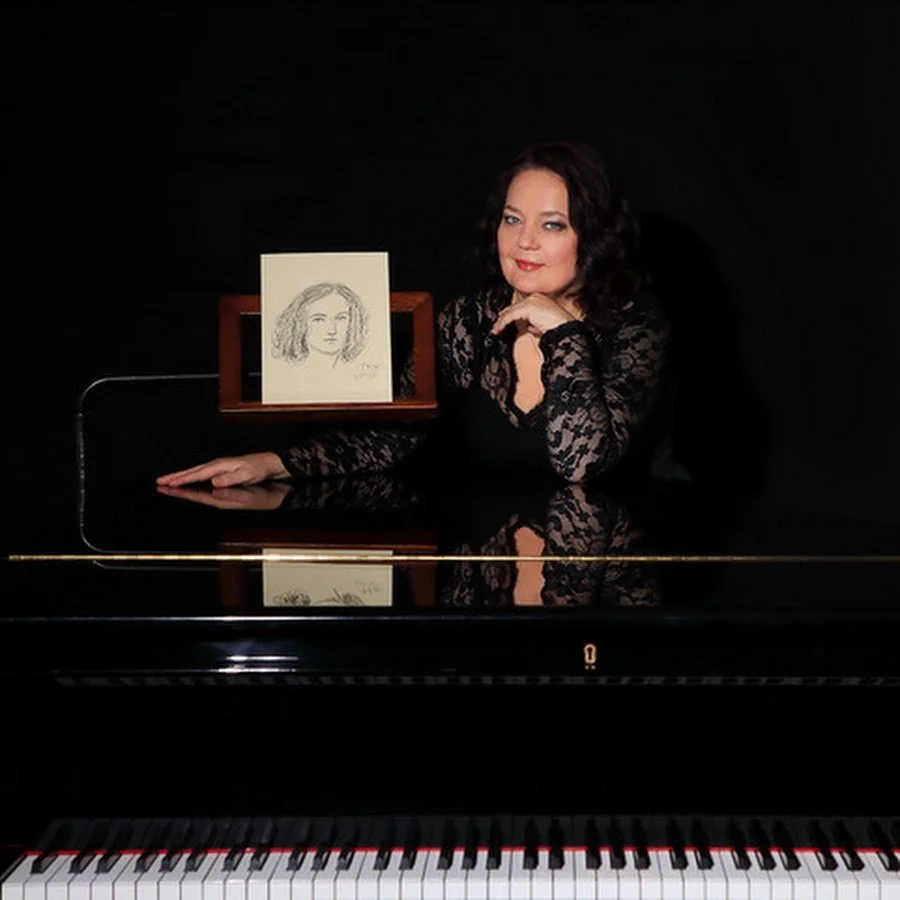
Following her critically-acclaimed recording projects of the entire solo piano works of Felix Mendelssohn, CPE Bach, and others, Hänssler Classic has released the first volume of Ana-Marija Markovina's "Fanny Mendelssohn Hensel: Complete Solo Piano Works" (HC2307). The four-disc set contains 78 tracks, half of which have never been recorded before.
We spoke with the pianist about the new album, recording complete cycles, misconceptions about Fanny Mendelssohn, and so much more.
You’ve recorded several complete sets of composers works. What insight do you gain from doing a complete set, opposed to a survey or sampling of someone’s catalogue throughout their life?
It was my quest for understanding that led me, at some point, to start exploring the composers behind the music. It was no longer enough for me simply to play the music; I wanted to know who had brought this music into the world. In a strange way, this developed into a friendship with the creators who have given us this music. And it was an exciting journey. So, as I immersed myself in the composers’ lives and the sources available on the subject, I came to know their entire body of work – from childhood right through to their final years. And so it was only a logical step to record their entire body of work as well.
The first complete collection was the recording of Hugo Wolf’s piano works. It was incredibly fascinating, even though he hadn’t left behind much music for the piano. And so I continued my work in this vein. Luisa Adolpha le Beau, Anton Urspruch, Anton Bruckner… they weren’t huge projects. But the complete recording of CPE Bach’s piano works was certainly a real challenge. I loved his work, immersing myself in his world, his era, his life. I worked as if in a fever and recorded 26 CDs in just 13 months. The next project was then the vast oeuvre of Felix Mendelssohn Bartholdy. And since I was already ‘at home’ with the Mendelssohn family, I went on to explore Fanny’s life.
Why did you choose Fanny Mendelssohn for this latest iteration of the “complete solo piano works” recordings?
Working on Fanny’s piano works was a logical next step, as I was already quite ‘close’ to the Mendelssohn family through my work on Felix. Fanny was always there in a way, and the more I got to know her, the more intriguing and fascinating I found her. She is a shining light.
I’m curious about logistics. How much research went into this project? What was already available in terms of scores? How did you catalog all of this, and make sure it was a fully complete set, in chronological order no less?
We owe the first step in systematizing Fanny’s work to Renate Hellwig-Unruh. She put everything in the right order.
And then HenselPushersranscribed and published many unpublished scores. A magnificent piece of work! We found what was missing in the Berlin State Library. But that wasn’t much. Otherwise, Furore-Verlag has already published a large number of her piano works – very well, in my opinion – and, of course, it is also well worth studying the source material, such as letters and biographies, insofar as they are available.
Tell us about the relationship that Fanny and her more famous sibling Felix had. Do you think this relationship manifested itself in one or the other’s music?
Her relationship with her brother is a fascinating subject. Of course, it is constantly evident in their music; the two were, after all, connected in an almost cosmic way. Fanny was a good three years older than Felix and thus ahead of him in every respect. She, too, was mature for her age – an old soul, one might say. She adored her little brother, and he looked up to her. I am convinced that his artistic development was accelerated and nurtured by his close bond with Fanny. Later on, he was able to ‘spread his wings’ in the wider world, something she was denied. She remained within her own circles in Berlin, where she nevertheless found her niche as a musician and enjoyed the highest acclaim. I think the siblings influenced one another, whilst respecting each other’s individual artistic personalities and enriching one another immeasurably.
What do you want people to know about Fanny? Are there misconceptions you’d like to set straight, or some significant facts that might be unknown to the casual classical music fan?
I hope that Fanny will be recognized as the great artist she was, with a musical style that was entirely her own. I hope that people will stop saying her music sounds a bit like Liszt’s, or like Felix’s, but that they’ll take Fanny as the benchmark and say: ‘Oh, that sounds just like Fanny Hensel.’ Fanny was a great soul, a wonderful person and completely independent. Fanny was Fanny, full stop. Her music is authentic, personal, passionate and direct. She was free; she was able to practice a lot, read, reflect and develop artistically without having to keep an eye on the market or worry about career progression or finances. This is an advantage for art that should not be underestimated.
What I would like to set the record straight on is the image of the oppressed woman. Yes, it is true that she had to wait longer than her brother to publish her works. But she did eventually publish them! And there can be no question of oppression in a household where one was brought up in the spirit of the great Enlightenment thinker Moses Mendelssohn. She received the best education available in her day. She associated with the greatest thinkers of her time, and with the great artists of her time, whom she invited to her home for concerts. She was a pianist, composer, manager and conductor; she was highly regarded and enjoyed the utmost recognition. She was taken seriously. She was an icon and highly influential. She simply started publishing a little late – that’s all. The family were also against it because they wanted to protect her, not hold her back. I believe that reducing her to the ‘invisible sister’ of her famous brother creates a false impression of Fanny. She was a giant of a woman.